
Home › Medical apps › Heparin Dosing

Heparin Dosing
Free on Android · ad-supported
Page last updated 5 November 2026
Heparin Dosing is a free heparin drip calculator for Android. It works out the starting bolus and infusion rate for an unfractionated heparin protocol, then how to adjust the rate after each aPTT or anti-Xa result, using a built-in protocol or one you create. It was written by a physician for medical, nursing and pharmacy students and clinicians learning how heparin nomograms work.
Screenshots
What it does
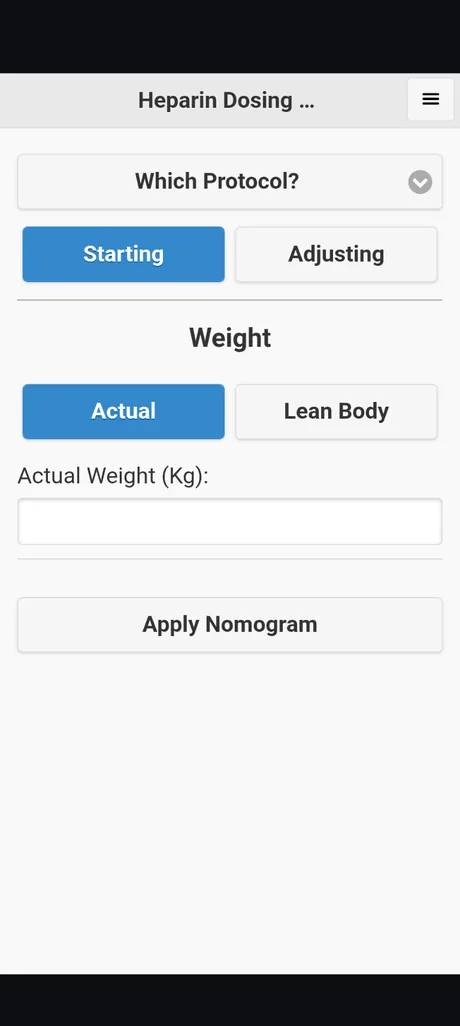
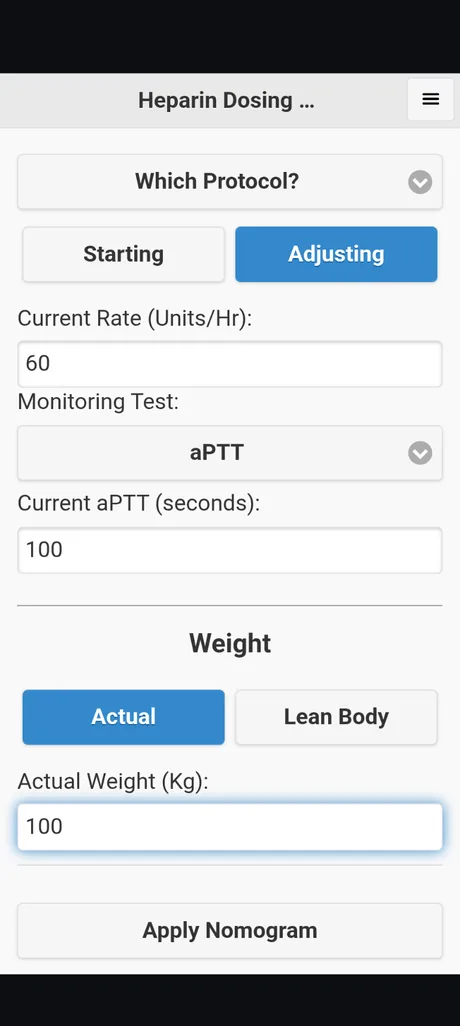
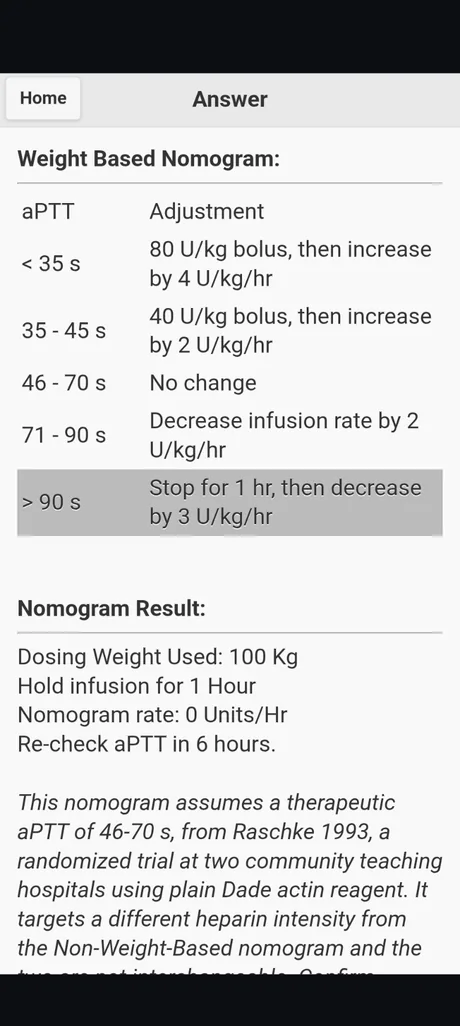
- Calculates the starting bolus and infusion rate, and the rate change after each aPTT or anti-Xa result.
- Comes with weight-based protocols for DVT/PE (with aPTT or anti-Xa monitoring), ACS/post-MI and UA/NSTEMI, each with a maximum bolus and rate.
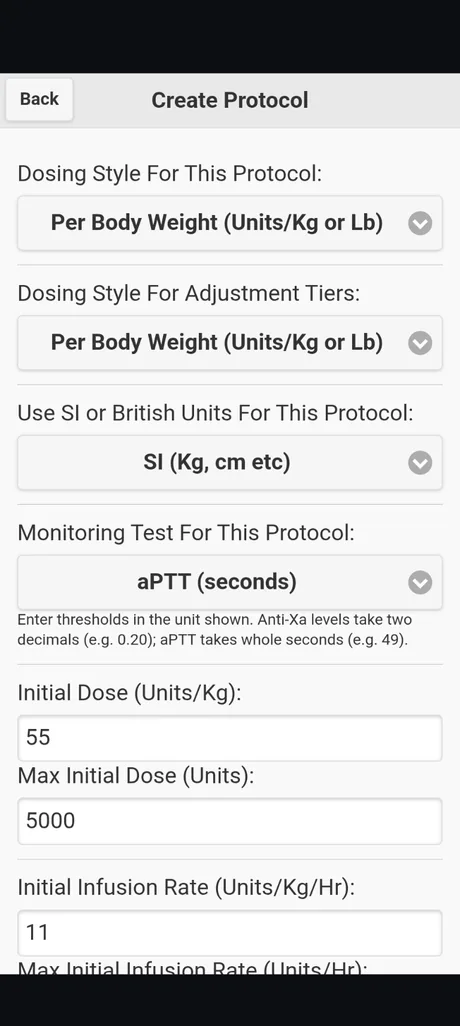
- Lets you create your own protocols, built around your hospital’s validated therapeutic range for aPTT or anti-Xa.
- Shows the full nomogram with your result highlighted, and when to re-check the level.
- Can calculate using actual or lean body weight.
- Can use SI or British units, and can round the dose to 25, 50 or 100.
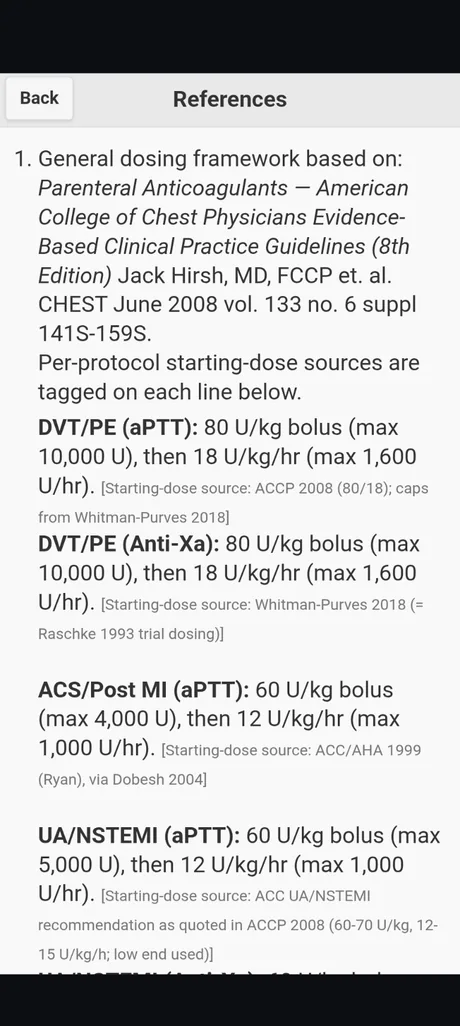
- A References screen lists the source of each built-in protocol’s starting dose.
Is the 2008 reference still current?
The app’s general dosing framework comes from the American College of Chest Physicians (ACCP) 8th edition guideline from 2008, and each built-in protocol names the source of its starting dose on the app’s References screen. For example, the DVT/PE protocol uses the 80 units/kg bolus and 18 units/kg/h infusion tested in the Raschke 1993 trial, with dose caps from Whitman-Purves 2018, and the acute coronary syndrome protocols start at 60 units/kg and 12 units/kg/h.
Newer guidance hasn’t changed the starting dose for venous thromboembolism. The ACCP 9th edition (2012) still suggests weight-adjusted dosing: 80 units/kg then 18 units/kg/h for venous thromboembolism, or 70 units/kg and 15 units/kg/h for cardiac or stroke patients, with a fixed 5,000-unit bolus and 1,000 units/h as an alternative.
What has changed most is monitoring. Many hospitals now adjust heparin by anti-factor Xa level instead of the aPTT, and therapeutic ranges differ from one hospital to another. So the app includes an anti-Xa version of the DVT/PE protocol and lets you build protocols around your own hospital’s validated range.
Why it isn’t on the App Store
Apple rejected the app under App Store Review Guideline 1.4.2, Drug dosage calculators. Apple only accepts a dosage calculator from a drug manufacturer, hospital, university, health insurance company, pharmacy or another entity it approves, or one with FDA (or equivalent) approval. Being written by a physician doesn’t count. We’ve chosen not to rework the app around those requirements, so Heparin Dosing is available on Google Play only. Read guideline 1.4.2 on Apple’s site.
Price, ads and privacy
Heparin Dosing is free and shows ads from Google AdMob. The weights and lab results you enter stay on your device: there are no accounts and nothing is sent to us. Read the Heparin Dosing privacy policy.
Questions
Is Heparin Dosing free?
Yes. It is free on Google Play and supported by ads.
Is there an iPhone version?
No. Apple doesn’t accept dosage calculators from individual developers, so the app is on Android only.
Does it support anti-Xa monitoring?
Yes. It includes an anti-Xa protocol for DVT/PE, and you can create your own protocols for either anti-Xa or aPTT monitoring.
Can I enter my hospital’s heparin protocol?
Yes. Create a protocol with your own starting dose, maximum bolus and rate, adjustment tiers and therapeutic range.
Does it support obese patients?
It can calculate using lean body weight, and every protocol caps the starting bolus and rate.
Can I use it to make treatment decisions?
No. Heparin Dosing is an educational tool. Always follow your institution’s protocol, pharmacy guidance and clinical judgment.
Sources
- Hirsh J, Bauer KA, Donati MB, Gould M, Samama MM, Weitz JI. Parenteral anticoagulants: American College of Chest Physicians Evidence-Based Clinical Practice Guidelines (8th Edition). Chest. 2008;133(6 Suppl):141S–159S.
- Garcia DA, Baglin TP, Weitz JI, Samama MM. Parenteral anticoagulants: Antithrombotic Therapy and Prevention of Thrombosis, 9th ed: American College of Chest Physicians Evidence-Based Clinical Practice Guidelines. Chest. 2012;141(2 Suppl):e24S–e43S.
- Raschke RA, Reilly BM, Guidry JR, Fontana JR, Srinivas S. The weight-based heparin dosing nomogram compared with a “standard care” nomogram: a randomized controlled trial. Ann Intern Med. 1993;119(9):874–881.
- Whitman-Purves E, Coons JC, Miller T, et al. Performance of anti-factor Xa versus activated partial thromboplastin time for heparin monitoring using multiple nomograms. Clin Appl Thromb Hemost. 2018. doi:10.1177/1076029617741363.
Heparin Dosing is for informational and educational purposes only. Please do not use it to guide actual patient care.