
Home › Medical apps › ABG Pro

ABG Pro
$1.99 on Android and iPhone · no ads
Page last updated 5 November 2026
ABG Pro is a $1.99 arterial blood gas (ABG) interpretation app for Android and iPhone, with no ads and nothing sent off your device. It works out every acid-base disorder in a blood gas, including triple acid-base problems, and gives a differential diagnosis for each one. It was written by a physician for medical students, nurses and doctors learning acid-base interpretation.
Screenshots
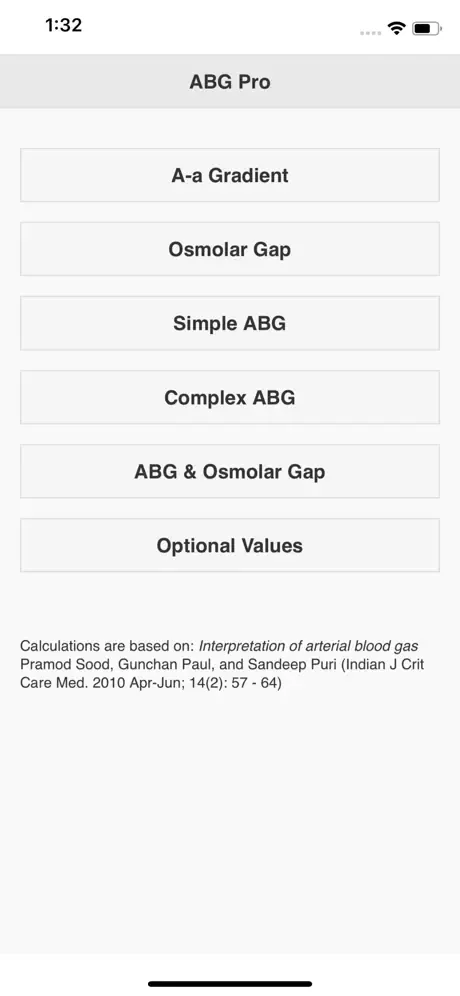
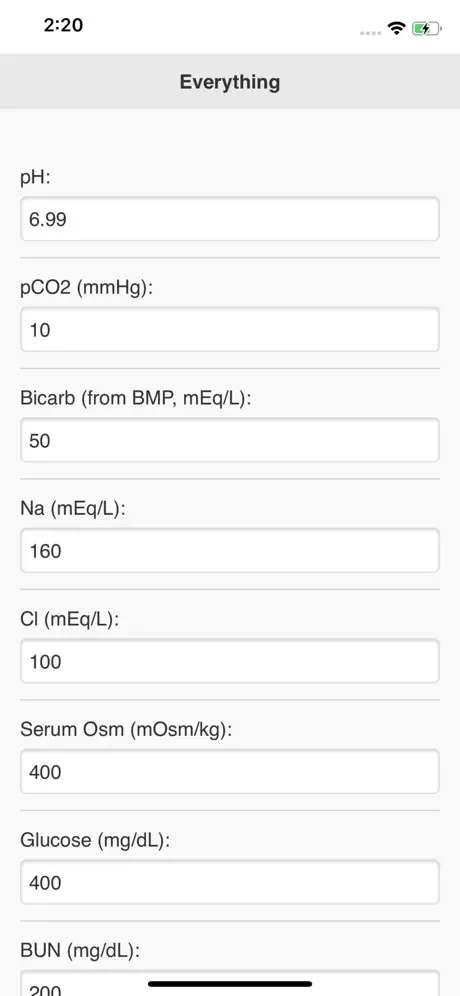
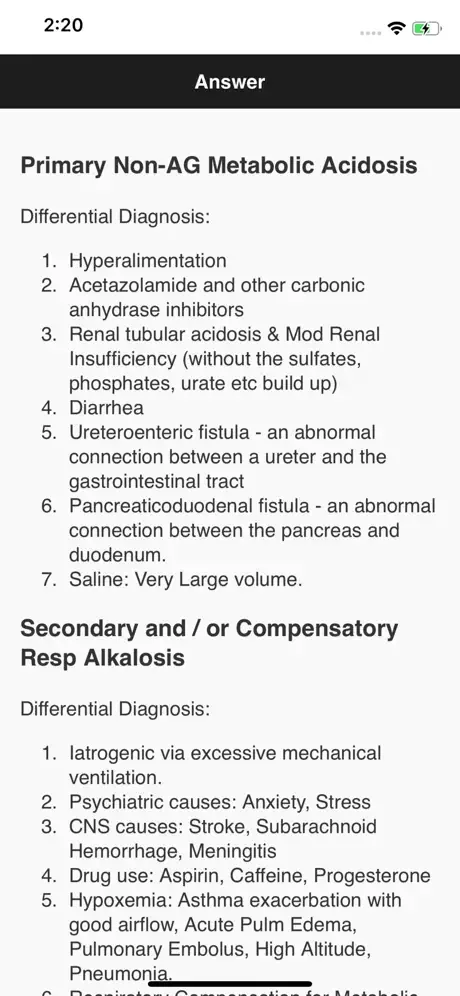
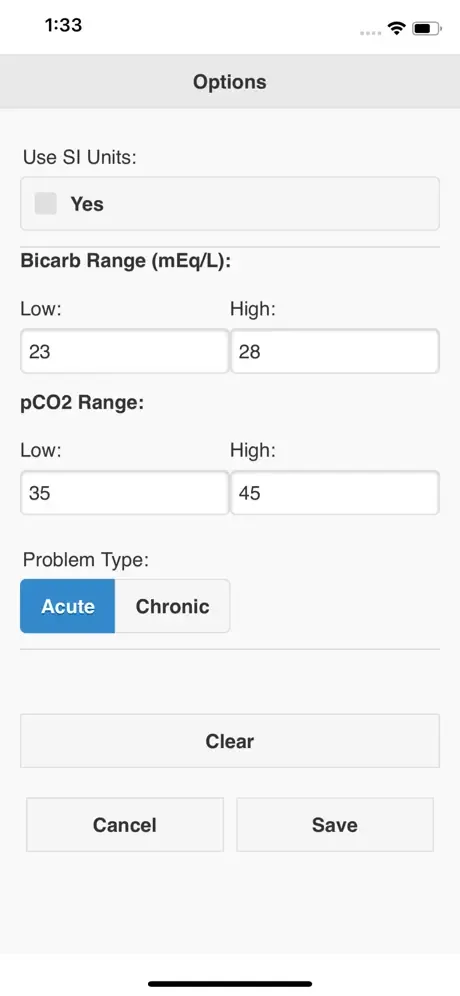
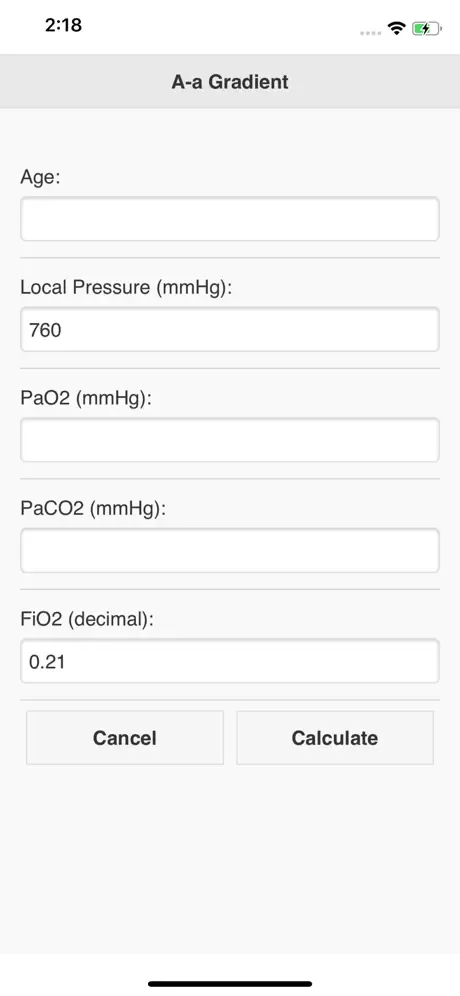
ABG Pro has the same features as our free app, ABG Pro DDx. Choose ABG Pro if you’d rather pay once than see ads.
What it interprets
- Arterial blood gases, including mixed and triple acid-base disorders.
- The osmolar gap, alongside the blood gas.
- A differential diagnosis for each disorder it finds, so you can see what to think about next.
- An acute or chronic setting, and conventional or SI units.
What it calculates
- Anion gap, corrected for albumin.
- Osmolar gap.
- Delta-delta.
- Expected pCO2 and expected bicarbonate (compensation).
- A-a gradient.
Settings you control
- Your own normal ranges for pCO2 and bicarbonate.
- Interpret without sodium and chloride when you don't have them.
- The app remembers these options after it closes.
Worked example
Try these values in ABG Pro: pH 7.45, pCO2 30, HCO3 20, Na 140, Cl 90, albumin 4.0. The pH looks normal, but the blood gas holds three disorders: an anion gap of 30 (normal for this albumin is 10) shows a high anion gap metabolic acidosis; a delta-delta of 4 reveals a metabolic alkalosis as well; and a pCO2 below the 36 to 40 that Winters’ formula predicts adds a respiratory alkalosis. See every step worked through in our ABG guide.
How it was tested
The interpretation logic has been stress-tested against more than 100 triple acid-base problems, drawn from acid-base textbooks and review books, published case reports and journal articles, and teaching cases from medical training.
Formulas and sources
ABG Pro’s calculations are based on the review Interpretation of arterial blood gas (Sood, Paul and Puri, 2010). It uses these standard acid-base formulas.
| Value | Formula |
|---|---|
| Anion gap (AG) | Na − (Cl + HCO3) |
| Normal anion gap, corrected for albumin | albumin (g/dL) × 2.5. A high anion gap is reported when the AG is more than 3 above this. |
| Delta-delta | (AG − normal AG) ÷ (25 − HCO3). Below 1: also a normal anion gap acidosis. 1 to 2: anion gap acidosis alone. Above 2 (or negative, when HCO3 is above 25): also a metabolic alkalosis. |
| Expected pCO2 in metabolic acidosis | Acute setting: 1.5 × HCO3 + 8 (Winters’ formula). Chronic setting: HCO3 + 15. |
| Expected pCO2 in metabolic alkalosis | 40 + 0.7 × (HCO3 − 25) |
| Expected HCO3 in respiratory acidosis | 25, rising 1 (acute) or 3.5 (chronic) for every 10 mmHg of pCO2 above 40 |
| Expected HCO3 in respiratory alkalosis | 25, falling 2 (acute) or 4.5 (chronic) for every 10 mmHg of pCO2 below 40 |
| Calculated osmolality | 2 × Na + glucose ÷ 18 + BUN ÷ 2.8 |
| Osmolar gap | Measured − calculated osmolality. Above 10 is reported as elevated. |
| A-a gradient | FiO2 × (barometric pressure − 47) − pCO2 ÷ 0.8 − PaO2. The normal value for age is (age + 10) ÷ 4, and the gradient is reported as elevated when it is more than 10 above that. |
The app reports an added respiratory disorder when the measured pCO2 is more than 5 mmHg from the predicted value, and an added metabolic disorder when the bicarbonate is more than 3 mEq/L from the predicted value. It uses 40 mmHg and 25 mEq/L as normal values, with default normal ranges of 35–45 mmHg for pCO2 and 23–28 mEq/L for bicarbonate, which you can change in settings. Units: pCO2 and PaO2 in mmHg; Na, Cl and HCO3 in mEq/L; albumin in g/dL; glucose and BUN in mg/dL. The app also accepts SI units.
Sources
- Sood P, Paul G, Puri S. Interpretation of arterial blood gas. Indian J Crit Care Med. 2010;14(2):57–64. The apps’ calculations are based on this review.
- Albert MS, Dell RB, Winters RW. Quantitative displacement of acid-base equilibrium in metabolic acidosis. Ann Intern Med. 1967;66(2):312–322.
- Figge J, Jabor A, Kazda A, Fencl V. Anion gap and hypoalbuminemia. Crit Care Med. 1998;26(11):1807–1810.
- Rastegar A. Use of the ΔAG/ΔHCO3− ratio in the diagnosis of mixed acid-base disorders. J Am Soc Nephrol. 2007;18(9):2429–2431.
- Kraut JA, Madias NE. Serum anion gap: its uses and limitations in clinical medicine. Clin J Am Soc Nephrol. 2007;2(1):162–174.
- Kraut JA, Xing SX. Approach to the evaluation of a patient with an increased serum osmolal gap and high-anion-gap metabolic acidosis. Am J Kidney Dis. 2011;58(3):480–484.
- Berend K, de Vries APJ, Gans ROB. Physiological approach to assessment of acid–base disturbances. N Engl J Med. 2014;371(15):1434–1445.
Price and privacy
ABG Pro is a one-time $1.99 purchase on Google Play or the App Store, with no ads, no subscriptions and no in-app purchases. Everything you enter stays on your device: there are no accounts, no analytics and nothing is sent to us. Read the ABG Pro privacy policy.
Questions
How much does ABG Pro cost?
$1.99, paid once through Google Play or the App Store. There are no ads, subscriptions or in-app purchases.
What is the difference between ABG Pro and ABG Pro DDx?
They have the same features. ABG Pro is paid and has no ads; ABG Pro DDx is free with ads that a one-time purchase removes.
Can it solve triple acid-base disorders?
Yes. It was built for triple acid-base problems and tested against more than 100 of them.
Does the app store patient information?
No. Values you enter are used on the device to do the interpretation and never leave it. The app has no sign-in.
Can I use it to make treatment decisions?
No. ABG Pro is an educational tool for learning acid-base interpretation. Always confirm results and follow your institution's protocols and clinical judgment.
ABG Pro is for informational and educational purposes only. Please do not use it to guide actual patient care.